Study: Milky Way Flipped 90° After Ancient Galaxy Crash
The Facts
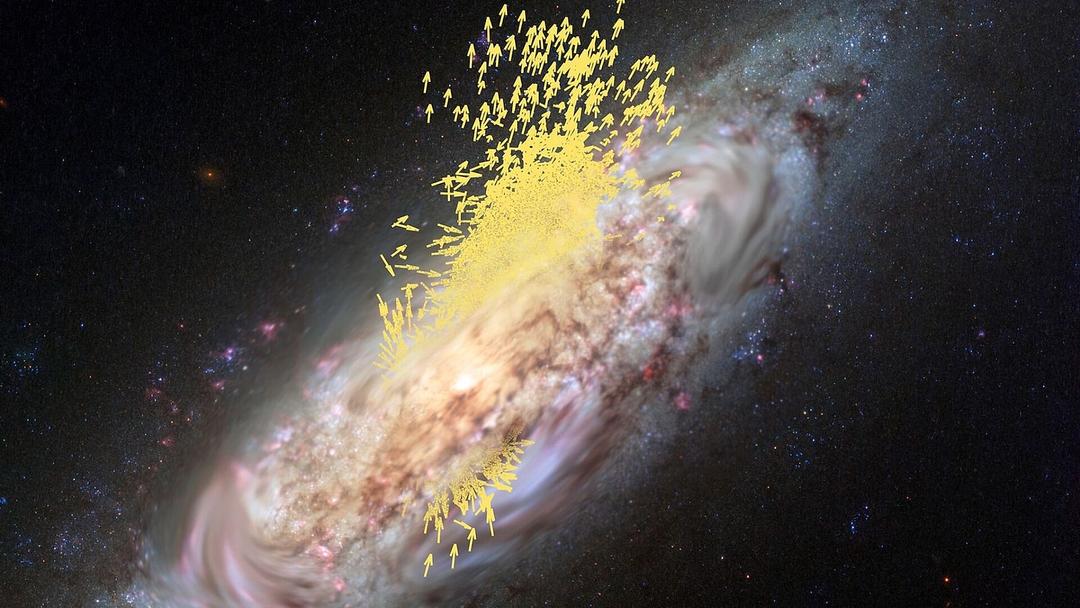
- Astronomers from Durham University presented research at the Royal Astronomical Society's National Astronomy Meeting in Birmingham on Tuesday suggesting the Milky Way's stellar disc may have shifted orientation by more than 90 degrees following an ancient galactic collision.
- The research, led by astronomer Kirill Batrakov, used the Auriga suite of cosmological simulations to analyze 25 Milky Way-like galaxies, finding that those with the slowest rotating stellar halos had each experienced a major head-on merger and a disc flip.
- The collision in question involved Gaia-Sausage-Enceladus, a massive dwarf galaxy that merged with the early Milky Way roughly 10 to 11 billion years ago, leaving billions of stars on highly elongated, sausage-shaped orbits.


Sources Split
LEFT
CENTER
RIGHT
+2
+1
+2
ESTAB
CRIT
CENTER
PRO
ESTAB
The Spin
Narrative A
The Milky Way's disc almost certainly flipped more than 90 degrees after a massive head-on collision with the Gaia-Sausage-Enceladus galaxy 10 to 11 billion years ago. Supercomputer simulations of 25 Milky Way-like galaxies show that slow stellar halo rotation is a direct fingerprint of that kind of catastrophic merger and disc reorientation. The Sun itself may have once traveled a completely different path through space. The galaxy's apparent stability today masks a violently transformed past.
Narrative B
Rather than simply rewriting the Milky Way's history, this study could reshape how astronomers investigate galaxy formation. If confirmed, the slow motion of ancient halo stars may preserve a record of the Milky Way's lost orientation, allowing scientists to reconstruct past mergers, trace the evolution of dark matter, and better understand how spiral galaxies — and our own solar system's cosmic environment — came to be.


Metaculus Prediction





© 2026 Improve the News Foundation.
All rights reserved.
Version 7.18.3