LZ Experiment Detects Possible Dark Matter Signal
The Facts
- Scientists at the LUX-ZEPLIN (LZ) experiment have recorded a single particle interaction that may represent the first hint of a dark matter detection. The result, announced at the 2026 TeV Particle Astrophysics conference in Japan, has not yet undergone peer review.
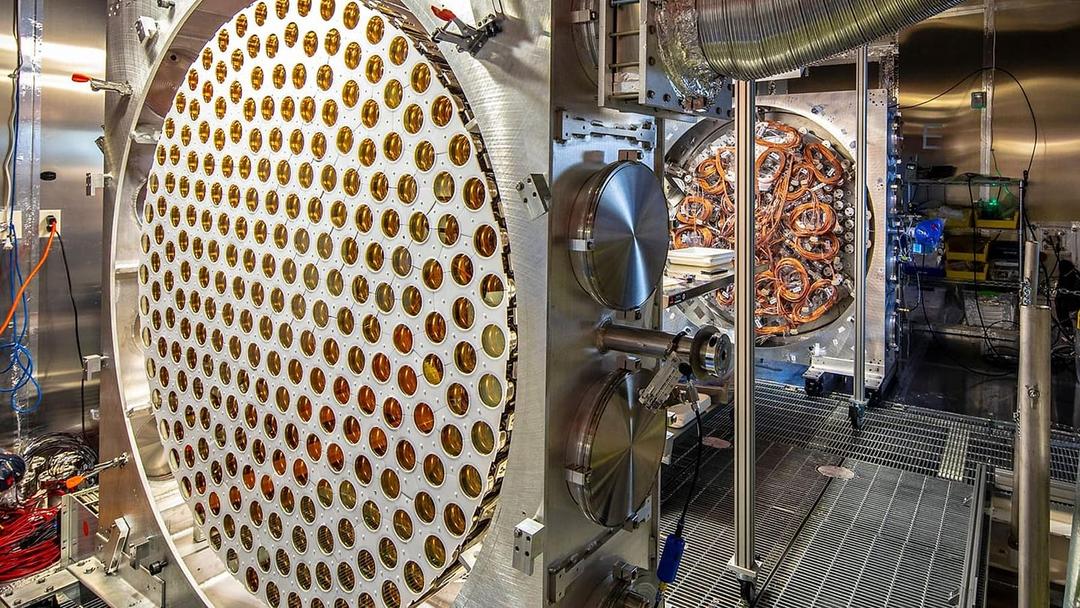
- The LZ detector, housed nearly a mile underground at the Sanford Underground Research Facility in South Dakota, uses 10 tons of ultrapure liquid xenon to search for weakly interacting massive particles, or WIMPs, which are among the leading candidates for dark matter.
- The anomalous event, recorded on June 16, 2023, registered a statistical significance of 2.6 sigma — well below the 5-sigma threshold required to claim a discovery in particle physics, leaving roughly a 0.5% chance the signal stems from known background processes.


Sources Split
LEFT
CENTER
RIGHT
+1
+1
+3


ESTAB
CRIT
CENTER
PRO
ESTAB
The Spin
Narrative A
The LZ experiment's detection of a potential WIMP signal at 2.6 sigma is the most promising dark matter candidate ever recorded. After decades of coming up empty, physicists finally have a glimmer of something real, a particle roughly 200 times the mass of a proton interacting with xenon in exactly the way theory predicts. Only a third of LZ's available data has been analyzed, meaning confirmation could realistically come within years.

Narrative B
A single unusual event from the LUX-ZEPLIN (LZ) experiment is intriguing, but hardly enough to overturn decades of failed dark-matter searches. The field has repeatedly built more sensitive detectors after previous candidates failed to appear, while theorists keep producing models that fit new anomalies. Even if this event survives scrutiny, scientists still need more data to show it isn't another statistical fluke or an obscure background process.
Metaculus Prediction
The Controversies




© 2026 Improve the News Foundation.
All rights reserved.
Version 7.18.2