Spain Deploys Military as Thousands Cross Into Ceuta
The Facts
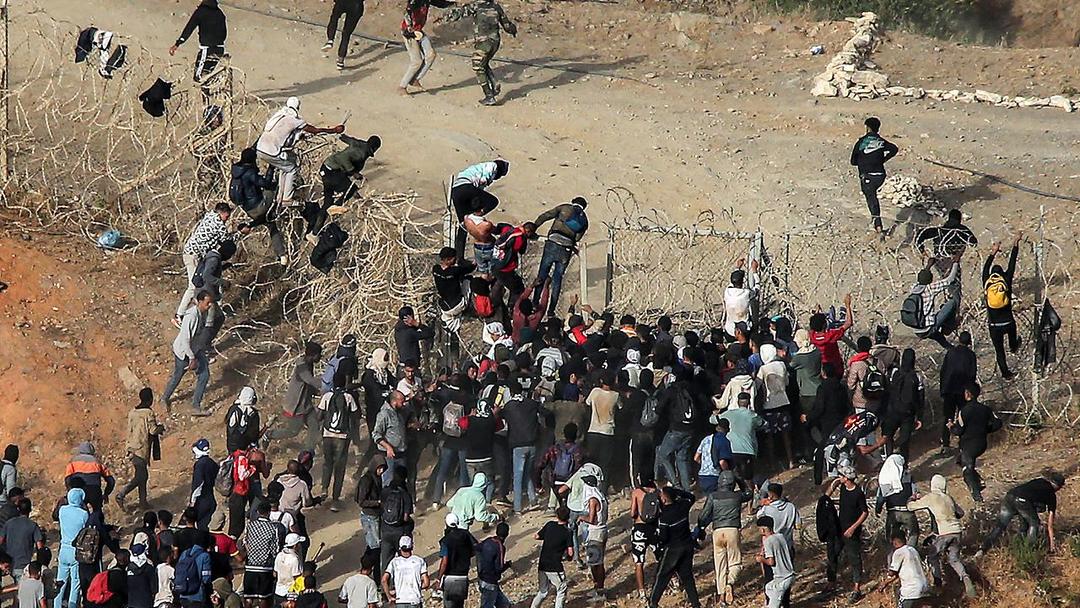
- Spain announced Thursday that it will deploy 60 troops and 200 additional police officers to Ceuta after thousands of migrants crossed into the North African enclave from Morocco by sea and on foot. Local authorities continue to press for a national emergency declaration.
- Thousands of migrants continued gathering near Ceuta overnight, attempting to reach the Spanish enclave despite reinforced Spanish and Moroccan security. At least 18 migrants died during the crossings as clashes with Moroccan security forces broke out near the border.
- Spain's Interior Ministry rejected Ceuta's request for a national emergency, arguing migration flows are not covered under the National Civil Protection System, though Interior Minister Fernando Grande-Marlaska did travel to Ceuta to further assess the situation.


Sources Split
LEFT
CENTER
RIGHT
+4


+2
+3
+1


+1
ESTAB
CRIT
CENTER
PRO
ESTAB
The Spin
Pro-government narrative
Ceuta's migration surge is a European challenge. Madrid is balancing border security with Spain's legal and humanitarian obligations while supporting local authorities under intense pressure. Military deployment may offer political symbolism, but lasting solutions require stronger EU cooperation, effective returns, and partnerships with countries of origin and transit — not emergency measures that fail to address the drivers of migration.


Government-critical narrative
Ceuta is in full-blown crisis, with more than 2,000 migrants overwhelming a city of just 84,000 people, yet Madrid's refusal to declare a national emergency amounts to a dereliction of duty. Local leaders are pleading for army deployment as reception centers buckle under the pressure and hundreds are forced to sleep on the streets. Spain's Supreme Court ruling banning sea pushbacks has further constrained authorities, leaving an already dire situation increasingly unmanageable.

Establishment-critical narrative
As Europe responds to renewed migration pressure in Ceuta, the West continues to portray migration primarily as an external security threat while overlooking its own role in creating many of today's refugee flows. Military interventions, regime-change campaigns and decades of economic and foreign policies have destabilized entire regions and displaced millions. Fortifying borders while ignoring these underlying drivers addresses the symptoms rather than the root causes of migration.
Anti-Trump narrative
As Spain confronts its biggest migration crisis since 2021, the Trump administration's increasingly pro-Morocco posture has emboldened Morocco to use Ceuta and Melilla as geopolitical leverage against an increasingly independent Spanish government. With mounting indications that migration is again being used as a tool of political pressure, Trump's confrontational diplomacy looks less like coincidence and more like deliberate geopolitical brinkmanship.

