At Least 160 Dead, Hundreds Missing in Nepal-Tibet Flash Floods

The Facts
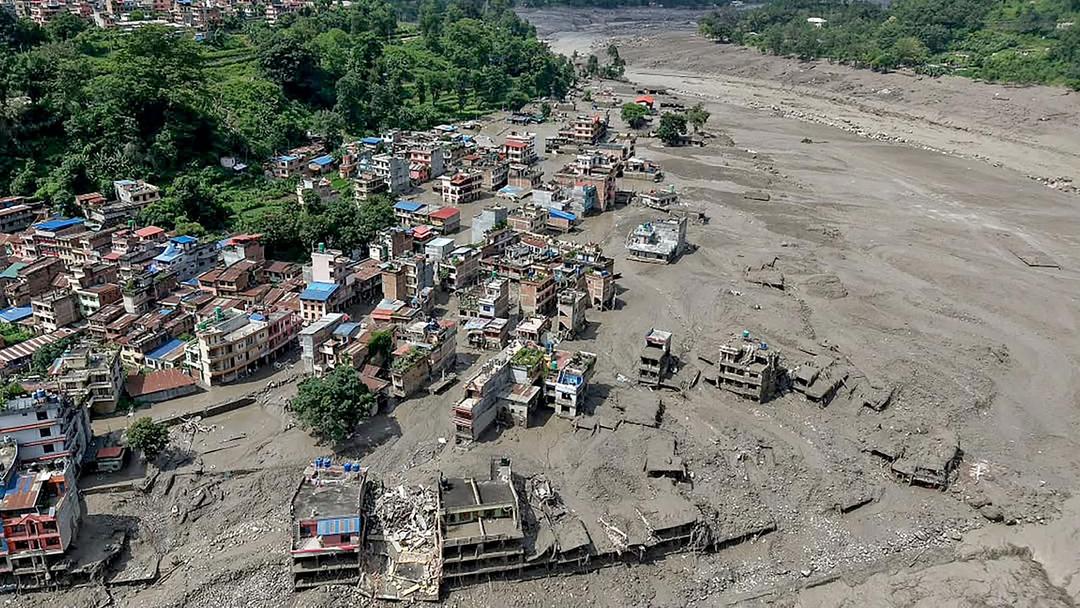
- At least 160 people have been killed and hundreds more are missing after flash flooding struck the Himalayan border region between Nepal and China's Tibet on Wednesday. Chinese authorities separately reported three dead and 265 missing on the Tibetan side.
- Nepal's foreign minister said a preliminary assessment indicated an earthquake around 8:37 a.m. local time may have triggered a landslide that blocked the Bhote Koshi River, sending a surge of water downstream. An ice-rock avalanche on the Lhende Khola River in Nepal is also suspected as a contributing factor.
- Nepali officials reported at least 579 people missing, including 466 foreign nationals from 28 countries. Among them were 100 from India, 54 from the U.S. and 33 from the U.K. Nearly 400 pilgrims were en route to the Kailash Mansarovar Yatra in Tibet when the flood struck.


Sources Split
LEFT
CENTER
RIGHT
+2

+2
+1
+2
+1
ESTAB
CRIT
CENTER
PRO
ESTAB
The Spin
Climate-concerned narrative
The Nepal-Tibet flash floods are a wake-up call about climate change gutting the Himalayas — glaciers are now losing ice twice as fast as in 2000, creating unstable lakes primed to burst. Building hydropower projects and settlements directly in glacial flood paths has made the devastation far worse than it needed to be. Without serious monitoring systems and climate-conscious development policies, disasters like this will keep coming.
Pro-government narrative
The Rasuwa flood highlights the government's swift response to an unprecedented, still-unexplained disaster. Authorities immediately launched rescue operations and coordinated with Chinese counterparts and experts to determine whether an earthquake-triggered landslide or avalanche caused the sudden surge. With conditions uncertain and infrastructure severely damaged, the government's priority remains saving lives and supporting affected communities.
Anti-China narrative
Nepal's deadly flooding has exposed the dangers of China's aggressive dam-building ambitions in the Himalayas. As rivers surge across South Asia, Beijing's massive Yarlung Tsangpo project raises fears of a far greater disaster in an earthquake-prone region, as a major failure could unleash enormous volumes of water downstream. China's pursuit of strategic control over vital rivers increasingly looks like a dangerous gamble with millions of lives.


Narrative D
The evidence so far points to a complex geologic disaster, not a settled case for broader political conclusions. Preliminary assessments indicate an earthquake may have triggered an ice-rock avalanche and landslide, while experts are still investigating the exact sequence of events. It is premature to use an unfolding emergency to assign blame to climate change or to China's broader infrastructure ambitions.