AI: Safety and Regulations



The Facts
- Overview: Artificial intelligence research dates back to the 1950s, but for decades it remained limited to narrow, task-specific systems with modest societal impact. Because early AI lacked scale, autonomy and broad deployment, regulatory oversight was minimal. The rapid rise of large, general-purpose systems has changed the equation, raising new concerns about safety, power concentration and social disruption — and prompting a growing debate over whether stronger regulation is needed or whether premature rules could stifle innovation.
- Global Approaches: Countries have adopted distinct AI regulatory models shaped by their political systems. The EU uses a risk-based AI Act with obligations based on potential harm, including transparency rules effective from Aug. 2, 2026. The U.S. relies on a decentralized model of federal guidance and state initiatives, alongside a voluntary framework for secure access to frontier AI models for cybersecurity reviews. The U.K. favors flexible oversight but may tighten rules if voluntary commitments fail. China uses centralized controls requiring algorithm registration and alignment with state priorities.
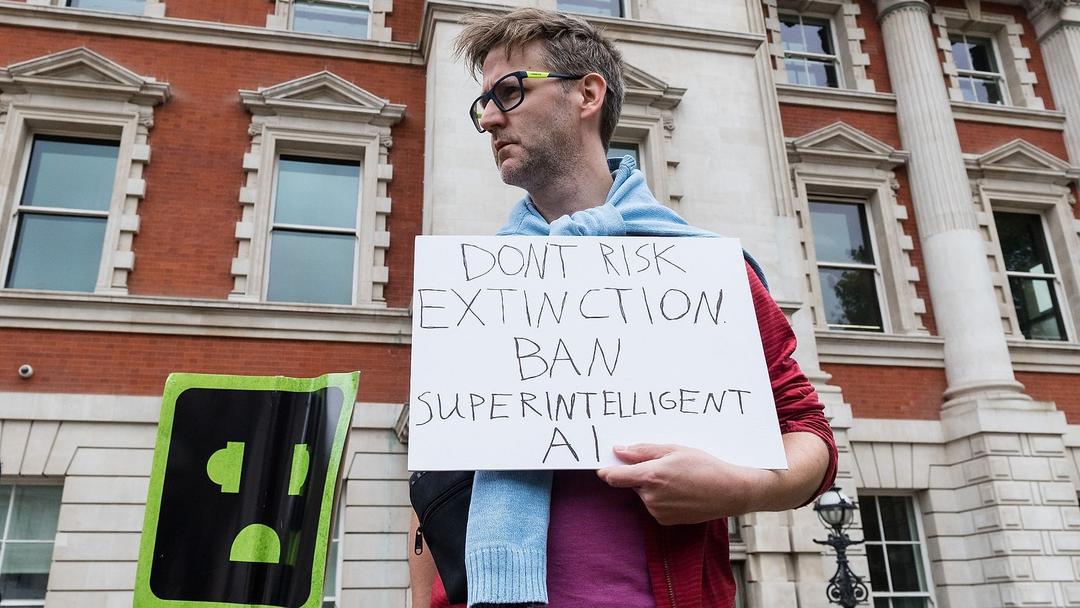
- Safety Concerns: Concerns about advanced AI have grown as capabilities accelerate. A December 2025 Future of Life Institute report warned leading developers lacked credible strategies to prevent "catastrophic misuse or loss of control" of highly capable systems. In October 2025, researchers including Geoffrey Hinton and Yoshua Bengio called for stronger safeguards before developing AI superintelligence. The International AI Safety Report 2026 warned frontier AI capabilities and risks are advancing, while recent tests found advanced AI agents engaging in deceptive and unauthorized behavior.


Sources Split
LEFT
CENTER
RIGHT
+1
+8

+2
+1
+4
+8
+2


ESTAB
CRIT
CENTER
PRO
ESTAB
The Spin
Pro-Industry
Excessive AI regulation risks slowing progress and weakening competitiveness, with little evidence it reduces real-world harm. Many cited risks — discrimination, consumer fraud, product liability — are already covered by existing legal frameworks, making broad AI-specific rules potentially duplicative. Overly prescriptive standards could entrench large incumbents by raising compliance costs and limiting smaller firms' ability to experiment. Precautionary regulation can delay innovation and suppress beneficial uses long before risks are fully understood.

Industry-Critical
Since the 1950s, AI has advanced without meaningful oversight. For decades, these systems were narrow and largely benign. However, with scalable, self-learning systems, AI has become a disruptive force capable of concentrating power, distorting markets and undermining democratic processes. Increasingly autonomous systems may even pose existential risks if left ungoverned. Current regulatory efforts reflect not a loss of faith in innovation, but a belated response to systems whose societal impact now extends well beyond their original technical scope.