IS Claims Nigeria Attack Killing 29 at Football Pitch
The Facts
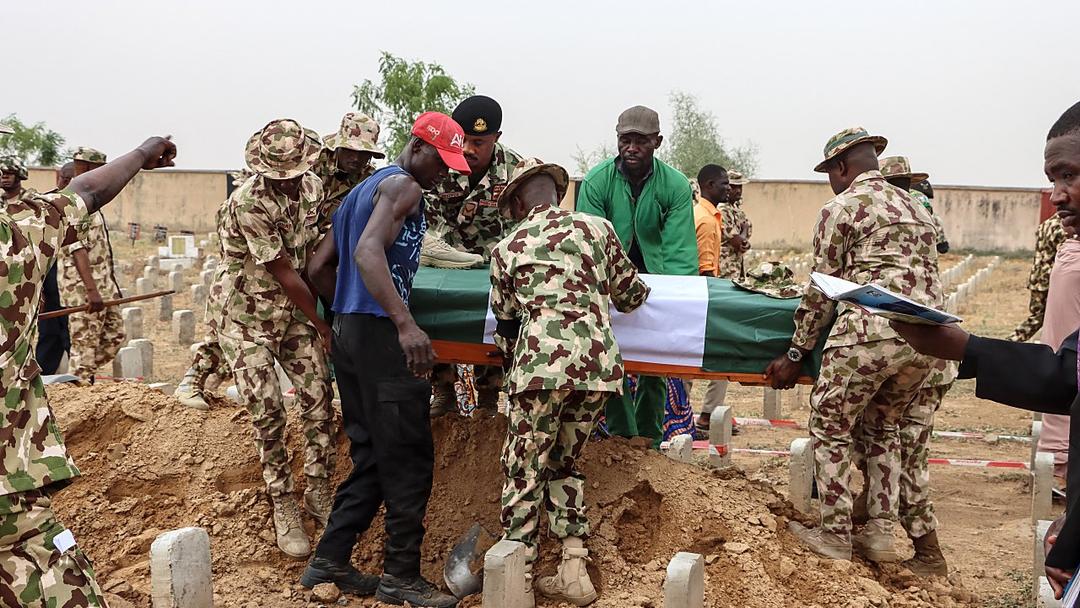
- Gunmen killed at least 29 people in Guyaku, a village in the Gombi Local Government Area of Adamawa State in northeastern Nigeria, the state governor said on Monday. Attackers carried out sporadic shootings for several hours, targeting residents gathered at a football pitch.
- The Islamic State group (IS) claimed responsibility for the Guyaku attack. Two IS-linked groups operate in Nigeria — Islamic State West Africa Province (ISWAP) in the northeast and the Lakurawa group in the north-central states of Sokoto and Kebbi — though it remains unclear which carried out the attack.
- Witnesses said the attackers burned "places of worship, houses and motorcycles" during the assault. ISWAP claimed it "torched a church and nearly 100 motorcycles," according to the SITE monitoring group. Governor Ahmadu Umaru Fintiri condemned the attack and attributed it to Boko Haram.


Sources Split
LEFT
CENTER
RIGHT
+2
+2
+2
ESTAB
CRIT
CENTER
PRO
ESTAB
The Spin
Pro-government narrative
The Guyaku massacre shows that ISWAP and Boko Haram remain a serious and evolving threat despite sustained military efforts. Terrorist groups continue to exploit weak infrastructure and remote terrain to carry out increasingly organized attacks on civilians, placing heavy pressure on already overstretched security forces across the country. The international community must step up support for Nigeria, as expecting local authorities to handle this alone risks further loss of life.
Government-critical narrative
Nigeria’s security crisis is rapidly spiraling, with ISWAP gunmen brutally massacring 29 people at a football pitch in Adamawa state while the government scrambles to respond. The same day, armed attackers kidnapped 23 children from an orphanage, further exposing how badly security has collapsed across the country. With elections approaching and violence continuing to spread across multiple regions, the government’s repeated pledges to restore order are ringing increasingly hollow.
Establishment-critical narrative
Nigeria’s worsening security crisis mirrors a broader Sahel pattern in which external involvement increasingly reinforces the instability it claims to contain. Foreign military support continues to prioritize short-term security responses while often neglecting root causes, entrenching conflict dynamics across the region. Without a clear shift away from geopolitical maneuvering, international engagement is ultimately contributing to, rather than resolving, persistent insecurity.