Congo, Rwanda Agree to Peace Steps in Washington Talks
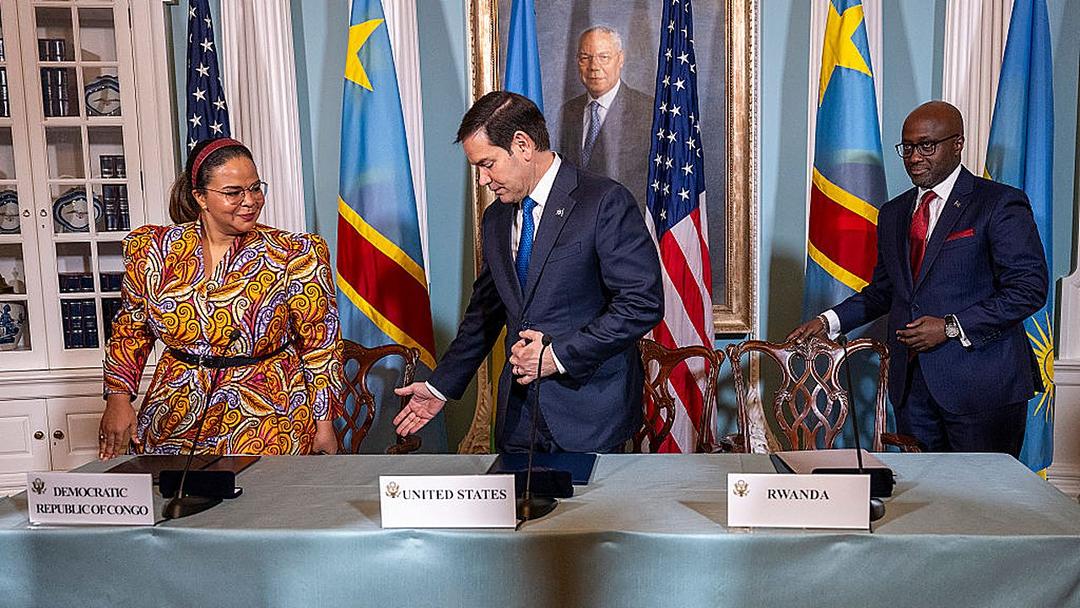

The Facts
- Representatives from the Democratic Republic of Congo (DRC) and Rwanda met in Washington and agreed to "concrete steps" to advance the Washington Peace Agreement, according to a joint statement released by the U.S., DRC and Rwanda.
- The joint statement outlined coordinated measures, including Rwanda's planned disengagement of forces and lifting of "defensive measures" by Kigali in defined areas of eastern Congo, alongside "time-bound and intensified" DRC efforts to neutralize the FDLR armed group.
- The Washington talks marked the first high-level engagement between the parties since the U.S. Treasury Department sanctioned the Rwanda Defence Force and four senior officers on March 2 over alleged support for the M23 rebel group and its affiliates in eastern DRC.


Sources Split
LEFT
CENTER
RIGHT
+1

+3
+3
+1

ESTAB
CRIT
CENTER
PRO
ESTAB
The Spin
Narrative A
Signing accords in Washington means little while eastern Congo’s crisis is actively sustained by Rwanda’s backing of M23 — a role now acknowledged by its own ambassador and met with recent U.S. sanctions. Kigali’s rhetoric of self-reliance signals defiance, not compliance, as it continues to exploit instability through armed proxies and mineral networks. Without firm enforcement and accountability for Rwanda’s actions, these agreements are just another pause before the next escalation.
Narrative B
The Washington Accords expose Kinshasa’s persistent failures — despite pledges to neutralize the FDLR, the group continues to operate, fueling insecurity across the east. Weak governance, fragmented command structures and tolerance of armed groups continue to undermine these commitments in practice. Even as pressure mounts on Rwanda, Congo’s inability to assert full and consistent control over its own territory remains a central and unresolved driver of the conflict.
Anti-Trump narrative
Trump's push around Congo is not about peace but control over critical minerals — Washington is leveraging diplomacy to secure access to cobalt, coltan and other strategic resources under the guise of conflict resolution. Backroom dealmaking prioritizes supply chains over Congolese sovereignty, sidelining local realities and deepening dependency. This is not a peace strategy but resource geopolitics, repackaged as diplomacy, while the underlying drivers of conflict remain untouched.


Metaculus Prediction
Public Figures
Go Deeper


© 2026 Improve the News Foundation.
All rights reserved.
Version 7.18.2